
“We use a separate basket for your fries.” That answers one equipment question, but an important detail remains: does the basket go into oil that also cooks wheat-battered food?
For shared fryers and gluten-free orders, ask about the food, the oil and the handling separately. A dish without gluten-containing ingredients can still encounter them during preparation. The American Gastroenterological Association’s cross-contact guidance recommends a designated gluten-free fryer with clean oil used only in that fryer.
You do not need to investigate the whole kitchen. Follow the fried item you are considering, and ask someone who can confirm how it would be prepared during your visit.
Check the food before the fryer
Start with the exact item: “Could you check the ingredients in these fries, including any coating and seasoning?” For chicken, fish, tofu or another fried dish, include marinades, batter, breadcrumbs, sauces and finishing garnishes.
A menu description such as “potato fries” or “crispy chicken” does not supply an ingredient list. Ask whether the food arrives ready-coated or is coated in the kitchen. If staff rely on a packaged product, ask whether they can check its current packaging rather than recall the ingredients from memory.
For an Indonesian restaurant conversation, useful details may include tepung used for coating, bumbu mixes, marinade and any kecap or bottled sauce. Those names identify components to investigate; they do not establish whether the actual product contains gluten.
Keep ingredient changes specific. “No batter” needs clarification if the portion has already been coated. Ask whether an uncoated portion is available before moving on to the cooking arrangement.
Ask what has cooked in the oil
The central question is: “Is the oil used for this dish also used to fry food containing wheat batter, breadcrumbs or other gluten-containing ingredients?” Include earlier use, rather than asking only what is cooking alongside your order.
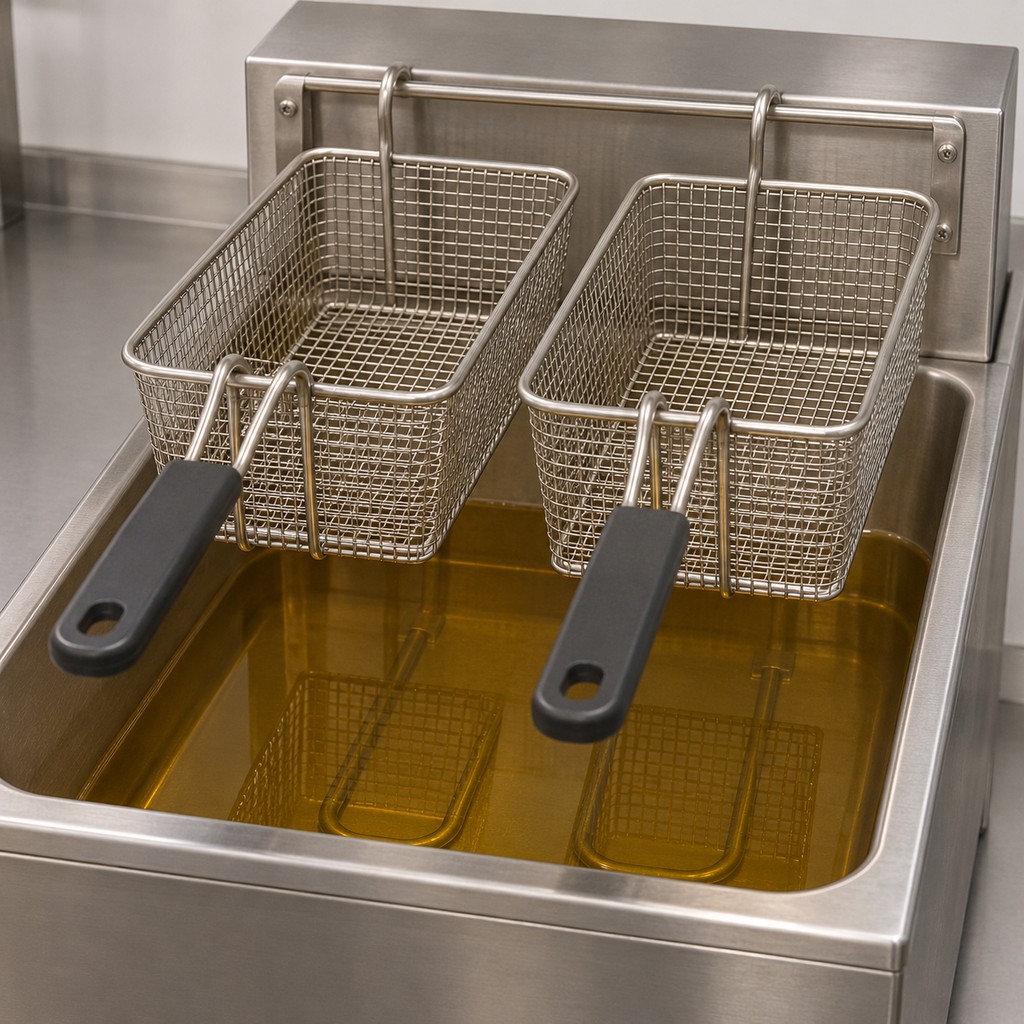
Coeliac UK’s cross-contact guidance advises clean oil or a separate fryer for gluten-free frying. This makes the oil’s use a necessary part of the conversation, even when the ingredients of your chosen food have been checked.
Follow the answer with whichever question remains relevant:
- “When you say separate fryer, do you mean a separate oil compartment, or another basket in the same oil?”
- “Which foods are allowed in that fryer?”
- “Has this oil been used for coated or breaded foods containing gluten?”
- “Is oil transferred between this fryer and another one?”
A reply about vegetable oil identifies the oil type. It leaves its cooking history unanswered. Similarly, “we fry your portion separately” could mean a different batch in the same oil. Ask staff to describe the arrangement in ordinary terms.
If the kitchen confirms that gluten-containing battered food uses the same oil, treat that as a shared-oil arrangement. For someone following a gluten-free diet for celiac disease, ask about an alternative consistent with the designated-fryer guidance above rather than treating a different basket as the solution.
Clarify baskets, tools and the route to the plate
Once the oil arrangement is understood, ask which basket, scoop or tongs will handle your portion and where the food will drain. A separate oil compartment leaves those later steps to explain.
Useful questions include: “Are the basket and serving tools reserved for this fryer?” and “Will my portion go into a shared holding tray or seasoning bowl?” Ask about anything added after frying, including seasoning, sauces and crispy garnishes.
Consider a hypothetical restaurant with a fryer used only for checked, uncoated potatoes. If staff then tip those potatoes into a tray also used for breaded snacks, the earlier fryer answer does not describe the finished serving arrangement. Ask how your portion would be drained, seasoned and plated.
You are seeking a practical account of the order: checked food enters the identified oil, comes out with appropriate tools, and reaches an identified plate. This is more useful than asking staff to promise that every part of the kitchen is gluten-free.
For questions covering other cooking methods and preparation areas, see questions to ask a restaurant about gluten cross-contact.
Turn reassuring replies into specific answers
A friendly response can be a starting point for clarification. Match your follow-up to the detail it leaves open.
| Staff reply | Follow-up question |
|---|---|
| “We use a separate basket.” | “Does it go into separate oil, and what else has cooked in that oil?” |
| “The oil is fresh.” | “Was the fryer cleaned before it was filled, and what has cooked in the oil since?” |
| “We filter the oil.” | “Is that oil still used for gluten-containing battered or breaded foods?” |
| “The fryer is very hot.” | “Could you confirm which foods use the oil and whether a separate arrangement is available?” |
| “We can fry yours first.” | “Would that be in a clean pan with unused oil, or in oil already used during an earlier service?” |
| “There is no flour in this dish.” | “Have the coating, seasoning and sauces been checked, and which fryer would be used?” |
Filtering, temperature and batch timing do not, by themselves, describe the separate preparation arrangement you asked about. Bring the conversation back to the food and equipment instead of trying to settle a technical debate at the table.
If staff give different answers, ask someone responsible for the kitchen to resolve the specific difference. “One person said the oil is shared and another said it is separate—could you check which applies to this order?” gives them a clear point to investigate.
Discuss an alternative the kitchen can actually provide
If the usual fryer shares oil with gluten-containing food, ask whether the kitchen has another method it can explain. One possibility to discuss is a clean pan with unused oil and clean utensils. Another is a different dish prepared using an arrangement that meets your requirements.
Treat these as questions for the kitchen. Do not assume that a restaurant has suitable cookware, time or space simply because an alternative sounds straightforward. A grilled or pan-cooked option still needs its ingredients, cooking surface and handling clarified.
A short English request could be:
Could someone from the kitchen check this dish’s coating and seasoning, what else cooks in its oil, and which basket and utensils would be used? If the oil is shared with gluten-containing food, is another preparation method available?
An Indonesian starting version is:
Apakah staf dapur bisa memeriksa bahan pelapis dan bumbu hidangan ini? Minyaknya juga dipakai untuk menggoreng makanan apa saja, dan keranjang serta alat mana yang akan digunakan? Jika minyaknya dipakai bersama makanan yang mengandung gluten, apakah ada cara memasak lain yang tersedia?
These are conversation examples, not medical translation cards. Explain your actual dietary requirement and any separate allergy accurately, then check that staff understand the preparation question.
Confirm the arrangement for this order
Before ordering, repeat the useful details: the dish, any ingredient changes, the fryer or alternative cooking method, and the serving arrangement. Ask whether the staff working that service can provide what was discussed.
If an important answer remains unknown, you can choose another dish whose preparation can be explained or use your backup meal. Our guide to planning a gluten-free restaurant visit in Indonesia covers those broader arrangements.
A detailed explanation helps you understand the proposed meal; it does not certify the restaurant or establish suitability for every person. Use appropriate healthcare guidance for your individual requirements. The useful endpoint is a clear account of what will happen to your food, with any remaining uncertainty left visible.