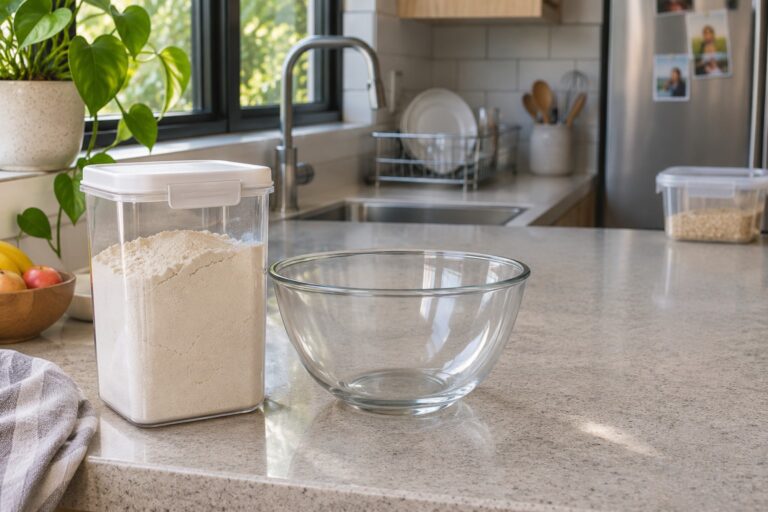
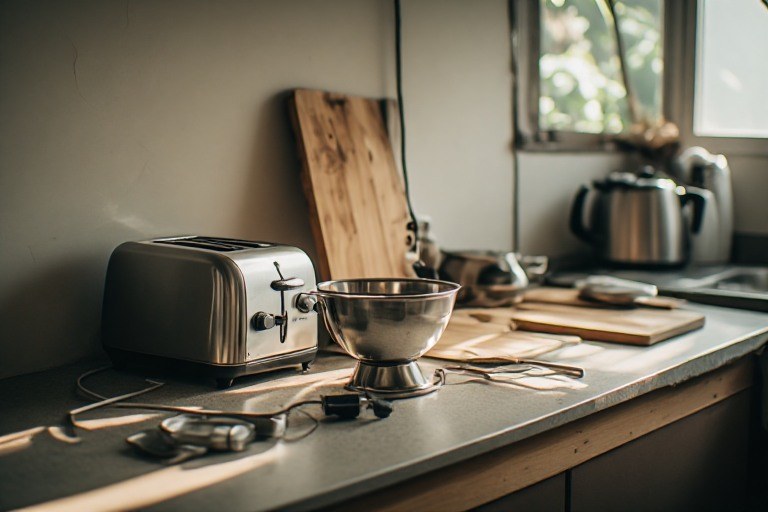
A second toaster takes up counter space. A separate colander needs somewhere to live. A cutting board reserved for gluten-free food only helps if everyone knows which one it is. Equipment decisions work best when the purchase and the household routine are planned together.
A useful gluten-free kitchen equipment plan gives each item a clear arrangement: share after cleaning, reserve for gluten-free preparation, or use a suitable alternative. The choice depends on the equipment’s design, its previous use and what your household can reliably manage.
This guide focuses on those equipment decisions. For the broader storage, preparation and serving framework, see managing gluten cross-contact in a shared home kitchen. Individual medical guidance remains important; an equipment plan cannot guarantee the absence of cross-contact.
Start with the food-contact parts
Before buying duplicates, look at the tools used for your usual meals. Include the bread knife, noodle strainer, chopping board, pan and serving utensils—not just the appliances on the counter.
For each item, ask three questions:
- What touches the food? Include blades, mesh, rims and removable inserts.
- Can those parts be reached and washed? Look for retained food and areas hidden by the construction.
- What happens after cleaning? Identify where the item dries, where it is stored and who might use it next.
Keep the item’s purpose specific. A colander used only to rinse vegetables has a different history from one used to drain wheat noodles. A board used for slicing bread needs a different household agreement from a board brought out clean for vegetable preparation.
These questions help organize decisions; they are not a home test for gluten. Appearance alone cannot establish that equipment is suitable for an individual’s needs.
Toasters: choose a repeatable breakfast arrangement
For bread toasted in a shared appliance, Coeliac UK’s home guidance recommends toaster bags or considering a separate toaster. Choose an arrangement people can follow during an ordinary rushed breakfast.
A dedicated toaster
If you choose a separate toaster, give it an identifiable position and explain that it is reserved for gluten-free bread. Placing two similar appliances side by side without a clear distinction leaves room for mistakes. A simple staff-applied label or agreed storage position can help household members identify the correct one.
Plan the space around it as well. Decide where bread is placed before toasting, which plate receives it and which knife is used afterward. A dedicated appliance does not resolve crumbs carried by another tool.
See others: How to Reduce Allergen Cross-Contact at Shared Preparation Stations
Toaster bags or another method
Toaster bags may be useful where counter space is limited. Check that the particular bag is intended for your appliance and follow both manufacturers’ instructions for use, cleaning and replacement. Keep its food-contact interior protected during storage and handling.
If bags are unavailable or incompatible, consider whether you need a toaster at all. A suitable, clean pan may provide a more manageable way to prepare bread. Establish the cleaning and handling routine before adopting that alternative.
Do not improvise appliance liners or barriers. Choose an option supported by the equipment instructions rather than assuming any heat-resistant material will work.
Colanders: make a separate decision about holes and mesh
A colander can be awkward to assess because its food-contact area includes more than the visible bowl. Examine the holes, mesh, rim and joins, particularly when it has been used for wheat pasta or noodles.
Coeliac UK’s food preparation booklet, on page 7, recommends separate pasta strainers and flour sieves. Reserving a clearly identified colander for gluten-free preparation is a practical way to follow that advice. This recommendation does not establish that every previously shared strainer is impossible to clean.
Choose a reserved item that is easy to wash and store. In a small kitchen, a compact strainer may be easier to keep separate than a large colander everyone borrows. Its size still needs to suit the food and quantity being prepared.
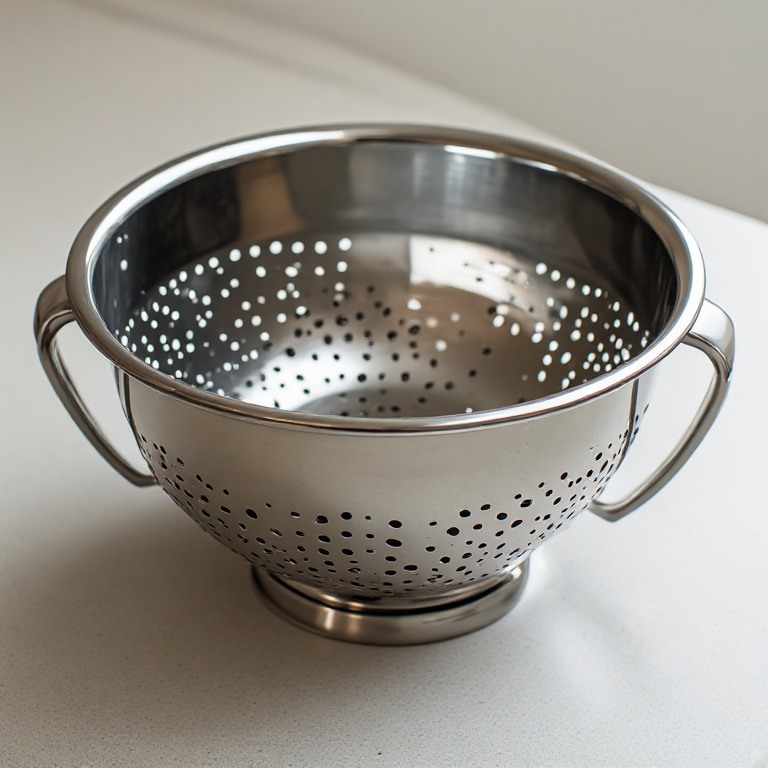
Make the draining step explicit. For example, a household preparing wheat noodles and gluten-free noodles could assign the reserved strainer to the gluten-free portion and place it in a clean receiving bowl. This is an organizational example, not a tested guarantee of suitability.
If there is no agreed draining arrangement, resolve it before cooking. A familiar shared colander should not become the last-minute default simply because the reserved one cannot be found.
Cutting boards: combine cleaning with clear identification
A separate board can simplify bread preparation, especially when several people use the kitchen. Coeliac UK suggests considering separate bread boards, while its preparation booklet also explains that washing-up liquid or a dishwasher can remove gluten from chopping boards and other washable kitchenware. A reserved board is therefore a practical arrangement, rather than evidence that all shared boards must be discarded.
Assess the actual board. Can you reach and clean the food-contact surface? Are there damaged areas or grooves holding food? Follow the manufacturer’s care instructions, including whether dishwasher cleaning is permitted. If retained food cannot be removed reliably, choose a different board or another suitable arrangement.
Do not decide from the material name alone. Calling a board “plastic” or “wooden” does not describe its condition, construction or cleaning history. Choose equipment whose care requirements your household can follow.
For a reserved board, explain its permitted use. A colored edge may help identify it, but the color has no universal meaning. Tell everyone whether it is reserved for gluten-free food and where it belongs after washing.
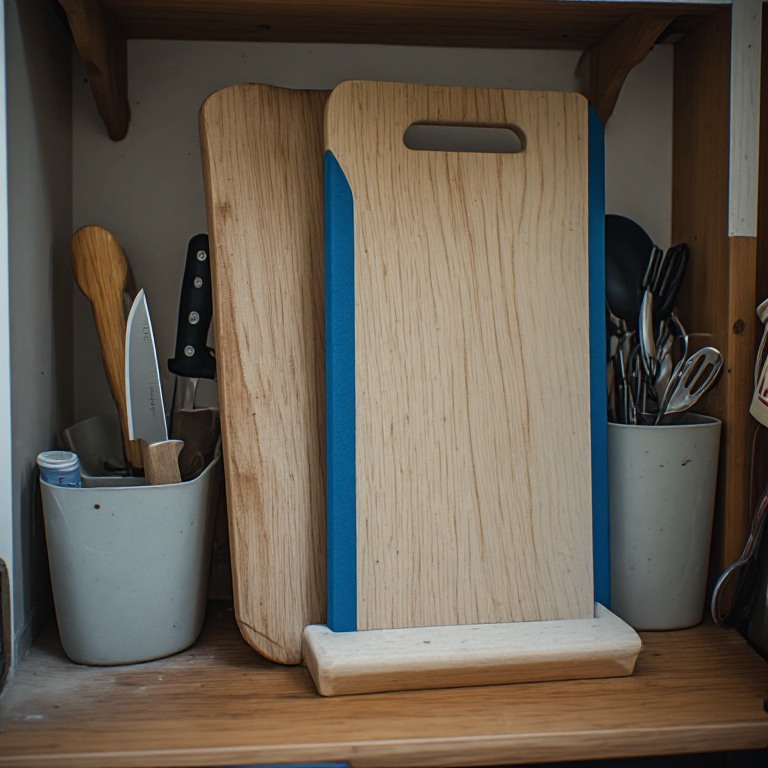
Pair the board with a clean knife and a clear work area. For the ingredient and container side of this routine, see organizing shared condiments and food storage for gluten-free meals.
Share washable equipment through a defined cleaning step
Smooth, accessible pots, bowls and ordinary utensils may be candidates for sharing after effective cleaning. Coeliac UK advises hot soapy water for kitchenware and identifies ordinary washing-up liquid or dishwasher cleaning as ways to remove gluten. Apply that guidance alongside the item’s care instructions; do not assume every electrical appliance or inaccessible component can be washed in the same way.
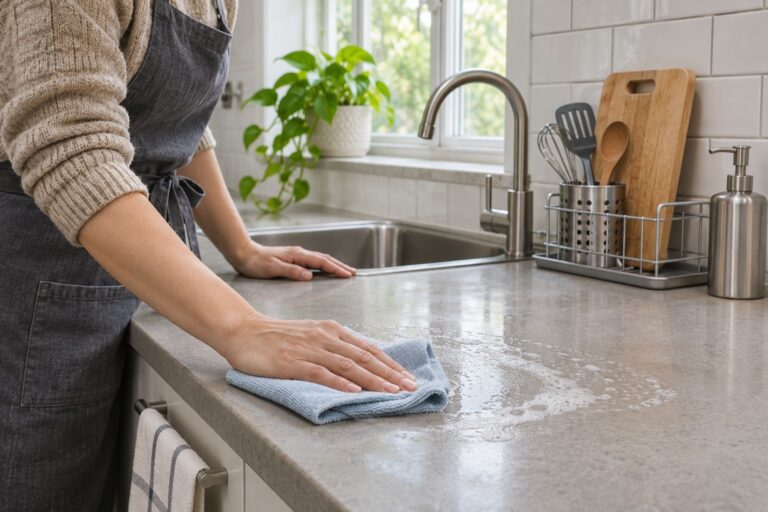
Make cleaning a transition between uses. Remove food residue, wash the accessible food-contact parts using the appropriate method, rinse as required and place the item in the clean storage or drying area. A quick wipe should not stand in for the agreed washing process.
Keep dedicated equipment in that routine too. “Reserved for gluten-free preparation” describes its intended use, not a reason to skip cleaning or ignore an accidental use for wheat-containing food. If that happens, reassess the item using the same questions about access and cleaning.
Read more: Gluten-free claims.
Write a short equipment plan people can use
Record decisions by item rather than leaving a general instruction to “keep things separate.” The following is an example to adapt to your kitchen and individual guidance.
| Item | Example household arrangement | Detail to settle |
|---|---|---|
| Toaster | Dedicated appliance or compatible toaster bags | Identification, storage and permitted use |
| Pasta colander | Reserved for gluten-free preparation | Where it is kept and who washes it |
| Bread board | Clearly identified reserved board | Matching knife and clean preparation space |
| Washable pan or bowl | Shared after the agreed cleaning step | Cleaning method and clean storage location |
| Hard-to-clean appliance | Decide before using it for gluten-free food | Accessible parts, manufacturer instructions and alternatives |
For example, a household in Indonesia might use the same washed saucepan for different meals but keep a separate strainer for gluten-free noodles. Another household might rarely drain noodles and instead prioritize a reserved bread board. These are different practical needs, not a universal shopping list.
Put the plan where the people cooking can find it, and explain it to anyone helping with meals. Include what to do when an item’s previous use is unknown: pause, identify a suitable clean or reserved alternative, and resolve the uncertainty before food touches it. The companion guide to preparing gluten-free and gluten-containing meals in the same kitchen develops the meal sequence beyond equipment selection.
Start with the equipment used most often and the decisions that currently cause confusion. A manageable plan lets the next person identify the right item, understand how it becomes ready for use and return it to its agreed place.