Your wedding RSVP includes a dietary-requirements box, or your conference registration shows “gluten-free” beside your name. That records a request. The next step is finding out what the catering team has agreed to provide and how the arrangement will work during service.
For gluten-free catering at weddings and conferences, follow the meal through three stages: the request reaching the kitchen, preparation of the agreed food, and delivery to the correct guest. You do not need to investigate every dish at the event. You need a workable arrangement for the meals you expect to eat, with important uncertainties left visible.
Find the person who can confirm the meal
Start with the organizer’s designated dietary contact. At a wedding, this might be the coordinator or venue manager; at a conference, it could be the registration team or event catering contact. Ask who can obtain answers from the people preparing the food.
Separate acknowledgment from confirmation. “We have noted your request” tells you that someone received it. Follow up with: “Has the caterer confirmed what they can provide, and who should I contact about ingredients and preparation?” If the organizer must relay questions, ask for the catering team’s answers in writing rather than relying on a general reassurance.
Explain your actual requirements. If you have celiac disease, say so accurately. State a wheat allergy or other food allergy separately, where applicable, and ask for that requirement to be addressed directly. Do not assume that “gluten-free” also communicates dairy-free, vegetarian, halal or another requirement.
Give the contact enough logistical detail to locate your booking: event name, date, guest or delegate name, and booking reference if used. Share only the health information needed to explain the meal requirement.
Establish which food services are covered
Ask for the complete scope of the arrangement. One confirmed main course does not answer what happens at the welcome reception, coffee break or evening food service.
At a wedding, discuss canapés, starters, the main meal, sauces, dessert, cake and any late meal you intend to eat. You may decide to skip some services, but make that an explicit choice instead of discovering the gap while other guests are eating.
At a conference, connect the request to each day and service. Ask whether it covers breakfast, refreshment breaks, lunch and any separately booked dinner. If an external reception or another venue is involved, establish whether it has received its own request.
| Point to confirm | Useful detail to obtain |
|---|---|
| Request deadline | When dietary information must reach the organizer and caterer |
| Meal coverage | Exact dates, meal services and courses included |
| Proposed food | Dish and accompaniments, or when the menu will be available |
| Additional requirements | Whether the same meal can meet each stated requirement |
| Collection or delivery | Where, when and from whom you receive the meal |
| Charges and alternatives | Any additional cost and what happens if catering cannot accommodate you |
For example, a hypothetical two-day conference might confirm a separate lunch on both days while providing no suitable refreshment-break food. That can still form part of a workable plan if you know the limitation early and arrange your own break food with the venue’s permission.
Ask about ingredients and preparation separately
Ask what is in the proposed meal, including sauces, marinades, seasoning, dressings and garnishes. For catering in Indonesia, questions might concern the actual kecap, stock powder or bumbu mix being used. The ingredient name alone does not establish the composition of the product in that kitchen.
Where an answer depends on a bought-in product, ask whether staff can check its current packaging or supplier information. A proposed grilled dish also needs its accompaniments explained; removing a final sauce does not answer what was used earlier in preparation.
Then discuss handling. Cross-contact means gluten is transferred to food that would otherwise be gluten-free. The NIDDK dietary guidance explains that this can happen during preparation and recommends discussing ingredients and preparation with restaurant staff. The same distinction is useful when asking about an event meal.
Keep questions tied to the proposed plate:
- Where will it be prepared, and how will surfaces and utensils be cleaned before use?
- Which cooking equipment will it use? If it includes a fried item, what else uses that fryer?
- How will the portion be kept separate during holding, transport and plating?
- Will any sauce, garnish or bread be added by another team during service?
A shared kitchen description leaves details to establish. Ask the caterer to explain its actual procedures and limitations. Likewise, a separately plated meal still needs an explanation of its ingredients and preparation.
If staff cannot answer a point that matters to your requirements, ask whether a simpler alternative would make the arrangement easier to explain. Keep any unresolved question in your record rather than treating silence as confirmation.
Agree how the correct meal will reach you
Ask how staff will connect the agreed meal to you during service. At a seated wedding, that might involve your name, table and seat, with a designated server confirming the plate. At a conference, it might mean collecting a meal from a named service point instead of joining the main buffet queue.
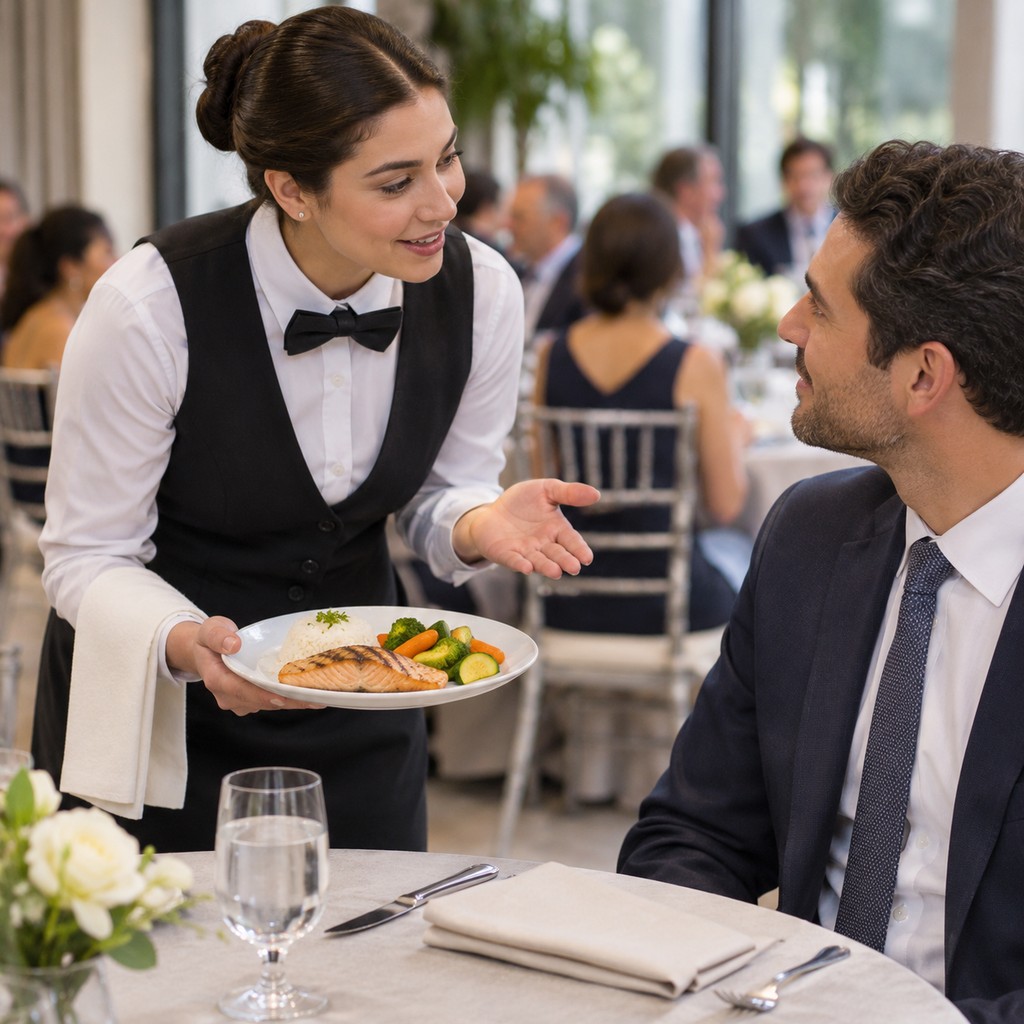
Establish what you need to do on arrival and who holds the meal information. A discreet identifier can help staff distinguish portions, but ask what it represents and how the server will confirm your meal. A label identifies a portion; the preparation conversation explains how it was made.
For a buffet, clarify whether the proposed alternative is prepared and plated before reaching the guest-accessible display, or simply collected from the same open trays. Our guide to ordering gluten-free at a buffet covers serving utensils, replenishment and questions to ask at the display itself.
Include courses delivered by another supplier. If a wedding cake comes from a separate bakery, ask who can explain that cake and its serving arrangements. A caterer’s confirmation about dinner should remain attached to dinner unless they explicitly address the cake too.
Keep a short written agreement
Save a compact record of the proposed food, services covered, contact person, delivery arrangement and unanswered questions. A long email chain is less useful during an event than one current message that clearly identifies the arrangement.
You could send:
I am attending [event] on [date] as [name or booking reference] and need a gluten-free meal. Please confirm which meals and courses are covered, what food is proposed, and what the catering team can explain about ingredients and procedures to reduce gluten cross-contact. How will my meal be identified and delivered or collected? Please also address [additional requirement, if applicable], tell me who to contact on the day, and identify anything you cannot confirm.
Ask when the menu and arrangement will be finalized. If you are planning the event yourself, include these details in the catering correspondence before committing to an arrangement that depends on them. If you are a guest, use the organizer’s agreed contact route so the kitchen receives one clear request.
Prepare for a substitution or missing meal
Before the event, ask what staff will do if an ingredient, dish or supplier changes. Request that substitutions affecting your meal be discussed with you before it is served. This is a communication arrangement, not a guarantee that the original plan will remain available.
On arrival, briefly confirm where to go and whom to ask. At a wedding, check that any table change has reached the service team. At a conference, establish the collection location before the lunch break begins.
When the plate arrives, confirm that it is the agreed meal. If it differs, pause and ask the designated contact to establish what changed, including ingredients and preparation. An unexpected garnish or sauce calls for clarification rather than an assumption that removing it restores the original arrangement.
Arrange a backup you can actually use. Ask about permission to bring food and any storage or heating you would need; do not build the alternative around facilities the venue has not confirmed. The Celiac Disease Foundation’s dining guidance recommends advance questions and a backup snack. For an event spanning several meals, consider whether your alternative would cover the gap if a full meal were unavailable.
The useful outcome is a short, specific account: which meals are covered, what the caterer can explain, how you receive your portion and what you will do if the arrangement changes. That lets you take part in the event with fewer food decisions left to solve during service.