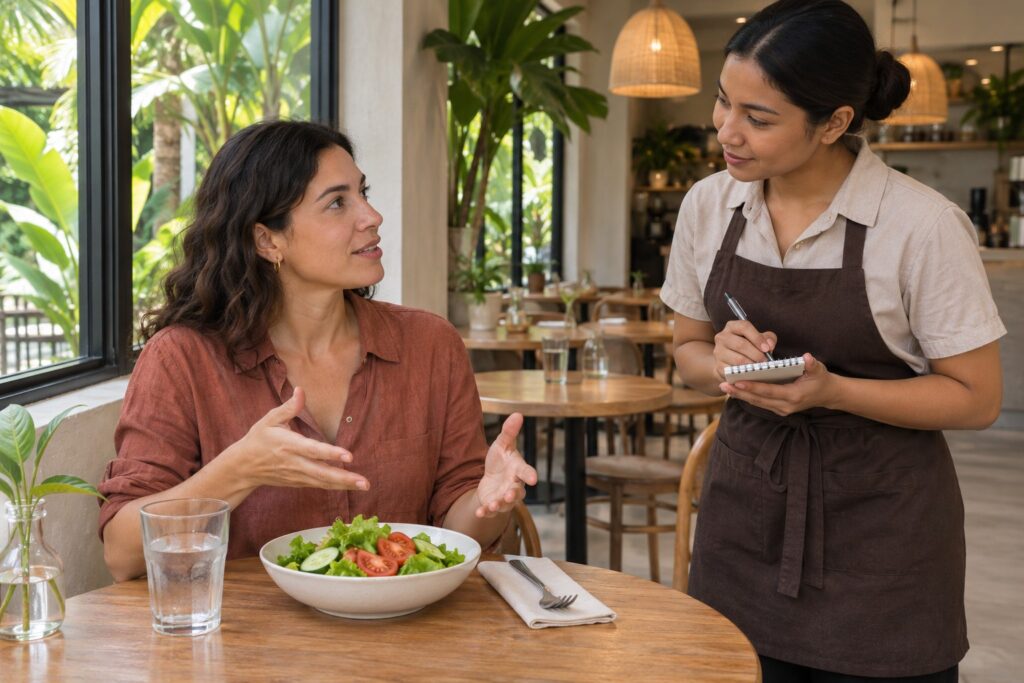
A server offers to remove the croutons from your salad. Before accepting, ask one more question: will the kitchen prepare your portion without them, or pick them out of a salad that already contains them? The offer sounds similar, but the preparation history is different.
Removing bread or croutons from a finished dish does not establish that the remaining food is gluten-free. If you need to avoid gluten cross-contact, ask for a fresh portion made without those items, then clarify the other ingredients and handling. A fresh plate alone does not answer those questions.
Ask what “remove” means before ordering
Start with a neutral question: “Has this dish already been assembled with the bread or croutons, or can my portion be prepared without them from the beginning?” This gives staff something concrete to check rather than asking them to interpret how much contact matters to you.
There are several possible answers:
| What staff describe | What to clarify next |
|---|---|
| Croutons are added separately just before serving | Can your portion be prepared and served without them, with suitable utensils and handling? |
| Bread is already touching the plated food | Can the kitchen make a fresh portion rather than lift the bread away? |
| Croutons are mixed through a batch of salad | Is there an unmixed supply of ingredients for a new portion? |
| A sandwich is already assembled | Can a new order be prepared from ingredients that have not already been assembled with bread? |
| Staff do not know when the topping is added | Can someone in the kitchen explain the actual process? |
These answers describe the next question to ask; none is a safety certification. A server may use “remove” casually when the kitchen actually means “leave off.” Clarifying the action avoids both unnecessary alarm and misplaced reassurance.
Why picking off the topping is different
Bread or croutons containing gluten can introduce gluten through contact with other food. The NIDDK guide to eating with celiac disease explains that cross-contact can happen during preparation and serving. Taking away the obvious pieces does not demonstrate that transferred gluten has also been removed.
For someone with celiac disease, picking croutons out of an already assembled salad is therefore not an adequate way to establish a gluten-free meal. Ask for a newly prepared portion using ingredients that have not already been mixed with the croutons. Likewise, moving the filling from an assembled sandwich onto another plate does not resolve its earlier contact with bread.
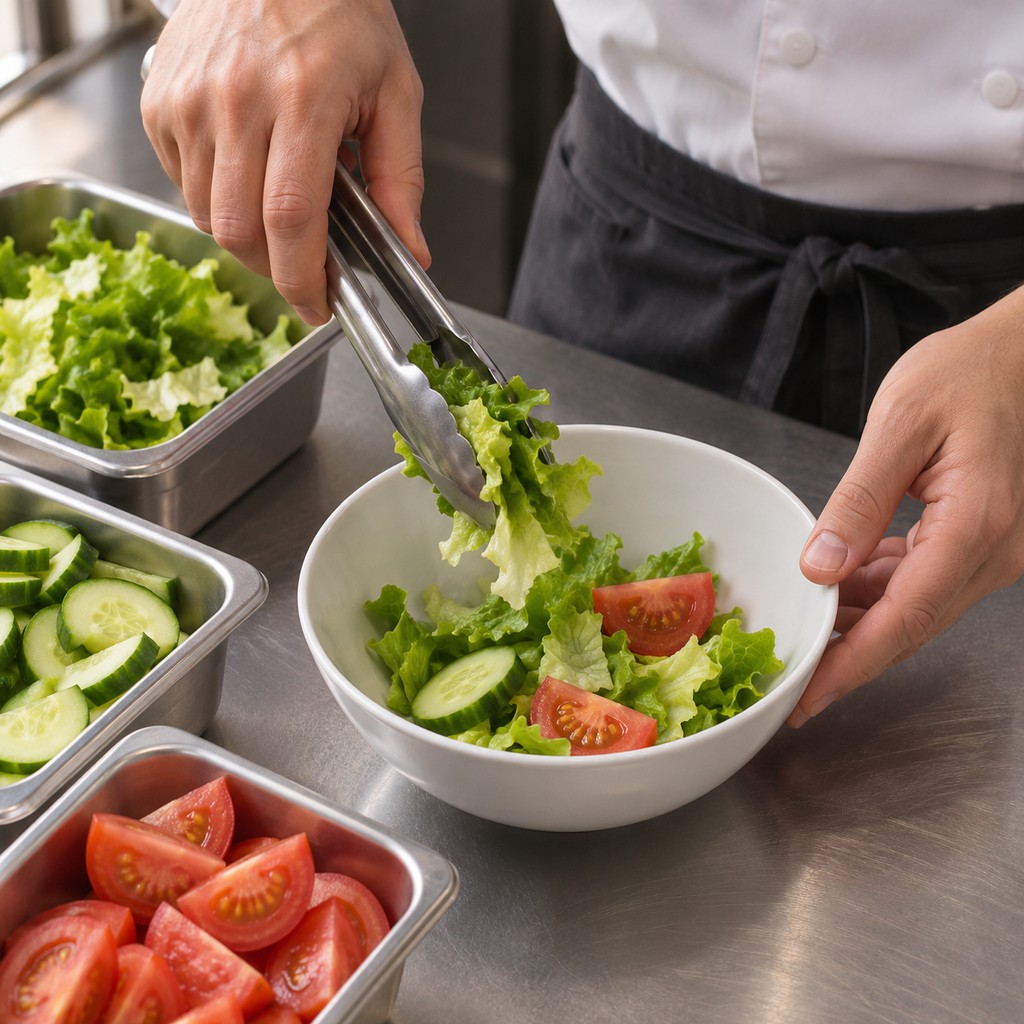
Consider a hypothetical café salad. If the kitchen keeps vegetables separately and adds croutons to each individual order, omitting the topping may be a workable change to investigate. If a bowl of salad has already been tossed with croutons, taking a serving from that bowl and removing the visible pieces is a different arrangement.
You do not need to estimate the number of crumbs or decide which leaves touched a crouton. The more useful question is whether the kitchen can start again with suitable ingredients and an explained preparation process. This article cannot determine the exposure from a particular plate.
Check what remains in the dish
A dish can still have unresolved ingredients after the bread is omitted. Ask about the components you will actually receive: dressing, sauce, marinade, seasoning, coating and any replacement garnish. Do not let the conversation end at the most visible source of gluten.
For a salad, ask staff to check the dressing and other toppings. For a burger served without its bun, ask about the patty ingredients, sauces and cooking arrangements. For soup normally accompanied by bread, establish whether the bread is simply served alongside it and separately check the soup’s ingredients.
In Indonesia, the same approach applies when staff offer to leave off crackers or a crispy garnish. Ask what the particular item contains rather than deciding from its name or appearance. If kecap, bottled dressing or a seasoning mix is part of the dish, ask whether the kitchen can check the current product ingredients.
The Celiac Disease Foundation’s dining guidance includes questions about salad toppings, dressings, marinades and preparation equipment. Its practical value here is to keep the discussion focused on the complete order, including the parts that remain after a substitution.
A proposed replacement also needs an answer. Swapping croutons for another crunchy topping introduces a new ingredient; it does not automatically resolve the request. You can ask for no replacement if that makes the order easier to explain.
Make the fresh-portion request specific
Say what you need the kitchen to do, then ask what it can actually provide. “Please remake it” can still leave uncertainty about whether staff will reuse the original food. A clearer request identifies both the fresh ingredients and the earlier contact you need to avoid.
An English starting point is:
I need a gluten-free meal and need to avoid gluten cross-contact. Could you prepare a fresh portion without bread or croutons, rather than remove them from an assembled dish? Please check the remaining ingredients and tell me how the preparation area and utensils will be handled.
For a conversation in Indonesian, you could begin with:
Saya perlu makanan bebas gluten dan perlu menghindari kontak silang dengan gluten. Apakah dapur bisa membuat porsi baru tanpa roti atau crouton sejak awal, bukan mengambilnya dari hidangan yang sudah jadi? Mohon periksa juga bahan lainnya, area persiapan, dan peralatan yang akan digunakan.
These are conversation examples, not medical translation cards. Describe celiac disease or a separate wheat allergy only if it accurately applies to you. Do not assume that a general gluten-free request communicates every allergy requirement.
Follow the preparation route of the dish. For a cold salad, the relevant discussion may be the mixing bowl, utensils, preparation surface and ingredient containers. For a bunless burger, cooking equipment and handling also need clarification. Ask whether staff can use a cleaned preparation area and clean utensils, and explain any limitations.
“Freshly prepared” answers when the dish is assembled. It does not, by itself, establish the ingredients or prevent cross-contact. You need those details together. For the broader venue-selection and ordering process, see planning a gluten-free restaurant visit in Indonesia.
If the dish arrives with bread or croutons
Pause before eating and explain the mismatch. You can say: “I ordered this without croutons because I need to avoid gluten cross-contact. Could you check whether a fresh portion can be made? Please do not just take the croutons off this one.”
If staff take the plate away, ask how the replacement will be prepared. A dish returning without the topping is not enough information to establish whether it was remade. Equally, its appearance alone cannot tell you what happened in the kitchen. Ask directly rather than trying to infer the answer.
If a companion offers to pick the bread off for you, a short explanation can help: “Thank you, but I need to check how the food was prepared, not just remove the visible bread.” You do not owe the table an extended medical explanation.
When staff cannot explain what happened, keep that uncertainty in the decision. Request another option whose ingredients and preparation can be clarified, or use your backup meal arrangement. A polite offer to help is welcome, but it cannot substitute for an answer about the food.
Know when to choose another option
A useful response tells you whether the food has already contacted bread, what a new portion would contain and how it would be handled. If those details remain unavailable, you can decline the dish without deciding that the entire restaurant is unsuitable in every circumstance.
Another order may be easier for the kitchen to accommodate. Ask about it as a new dish rather than assuming that something plainer meets your requirements. If the kitchen cannot provide a suitable arrangement, choosing another meal is a practical response to a limitation.
The question to settle is specific: can this portion be prepared without the bread or croutons from the outset, with its remaining ingredients and handling explained? That gives you more useful information than a promise that the visible topping can disappear.