
The snack you usually buy has a new wrapper. The name looks the same, but the gluten-free statement is harder to find and the seasoning list seems longer. Has the recipe changed, or only the design? The front of the pack cannot answer that on its own.
Rechecking a familiar product for gluten starts with the package you intend to buy or use. Compare what it says now with what you previously relied on, then investigate any difference that matters to your decision. A new design does not automatically mean a new recipe, and an unchanged design does not establish that everything inside is unchanged.
Start with the exact package
Check the full product name, flavor or variety, pack size, manufacturer, and country or market information. Similar-looking items can be different products: a plain snack and its seasoned version, for example, need separate checks. A larger pack or a multipack should also be read on its own merits rather than assumed to match the smaller pack.
For a product sold in Indonesia, read the original packaging and any Indonesian supplementary label together. Make sure they appear to describe the same product and variant. If an online shop shows only the front, request clear, current photographs of the ingredient list, allergen information, gluten-related claim, and identifying details before relying on the listing.
The U.S. Food and Drug Administration advises checking labels each time a food is purchased because ingredients can change. That is a useful shopping practice; the FDA advice does not establish Indonesian labeling requirements.
Compare the information that supports your decision
Read the current ingredient list in full, including the components of any seasoning, filling, coating, or sauce that are listed. Then look separately at allergen information, precautionary wording, and any gluten-free claim. These parts of a label answer different questions; a reassuring statement in one place does not make an unclear ingredient elsewhere disappear.
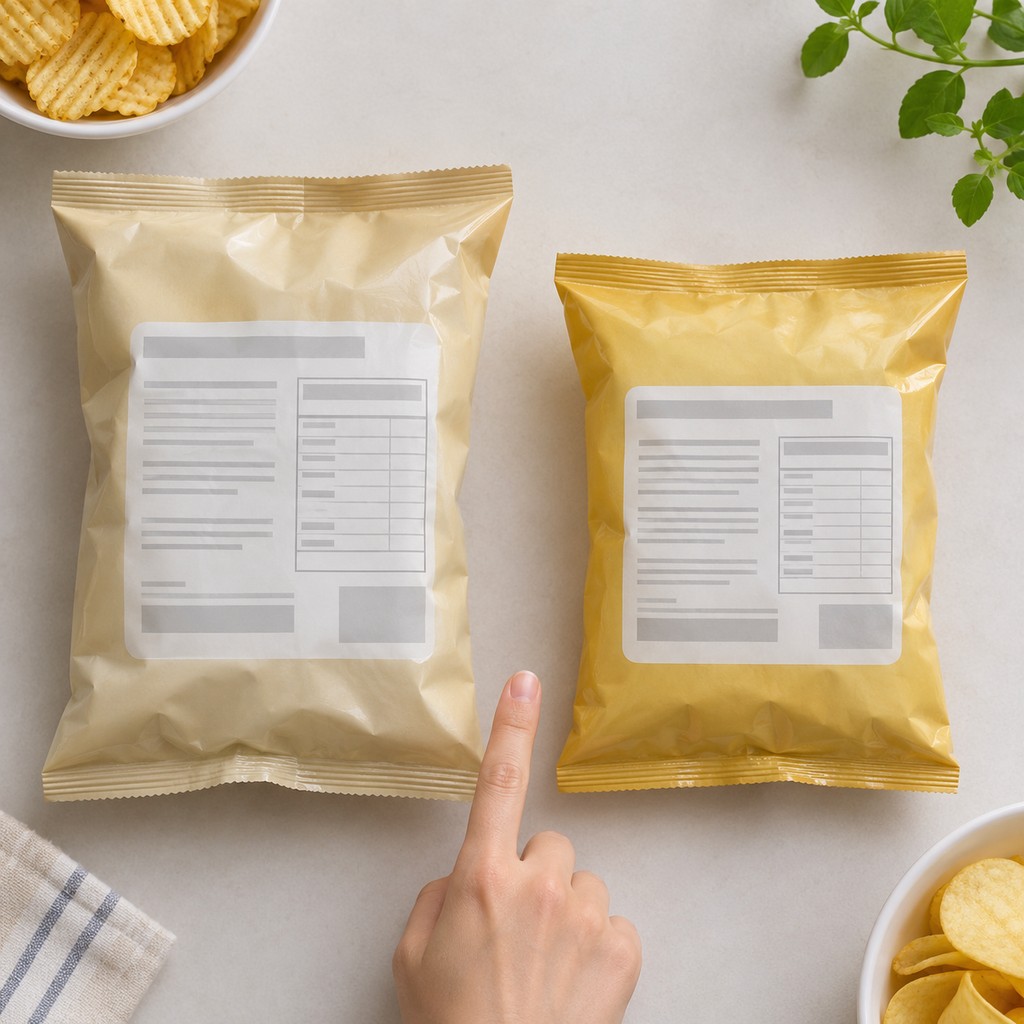
If you have an older package or photograph, compare it with the new one. Pay particular attention to:
- Ingredients: Has a component been added, removed, renamed, or described less specifically? Check the source of an unfamiliar grain-derived ingredient when it matters to your diet.
- Allergen and precautionary statements: Has the wording about a named allergen or possible shared production changed? Record the actual wording rather than assuming why it changed.
- Gluten-free claim: Is the claim still present, and does it apply to this exact product? A missing claim is a reason to seek clarification, not proof by itself that gluten was added.
- Product identity: Are the flavor, manufacturer, importer, pack size, and market version the same as those in your earlier record?
An identical-looking ingredient list is helpful information, but it does not by itself explain whether production arrangements have changed. Equally, a revised warning does not tell you on its own what changed in the factory. Ask the company about the specific point if that information is necessary for your decision.
For a broader explanation of ingredients, statements, and the Indonesian labeling context, see Reading Food Labels for Gluten in Indonesia: A Practical Decision Guide.
Separate a visible change from an unanswered question
Suppose a hypothetical rice snack once listed a simple salt seasoning. The new package lists a mixed seasoning but does not explain one of its components. The useful question is not whether all rice snacks are suitable; it is what that component contains in this particular variety. Until the manufacturer clarifies it, the ingredient remains an information gap.
Or imagine the ingredients look the same, but a gluten-free claim you previously used is no longer visible. Check all panels, including the supplementary label. If you still cannot find it, ask whether the claim applies to this version and why the current pack differs from the information you have. A website image of an older package is not enough to establish what applies to the pack in your hand.
If a label says “wheat-free,” do not treat that wording alone as a complete gluten assessment. Wheat is one source of gluten; barley and rye are relevant too. The Celiac Disease Foundation’s overview of gluten sources explains that wheat-free and gluten-free are not interchangeable descriptions.
Ask about the specific pack when details remain unclear
Keep the package or take clear photographs of its front, ingredient list, statements, and any supplementary label. Include the barcode, batch or lot code, date, flavor, and pack size where available. These details help a manufacturer or importer identify the version you are asking about; they do not establish gluten status by themselves.
Contact the manufacturer using the package details or its official contact channel. For an imported food sold in Indonesia, the named importer or distributor may be able to help or refer your question to the manufacturer. Ask one or two focused questions, such as:
I previously bought [product and variety]. The package I have now shows [exact changed or unclear wording]. Does your answer cover this pack size, batch and version sold in Indonesia? What is the source of [ingredient], and what can you tell me about the gluten-free claim and relevant cross-contact controls for this product?
Use only the parts that address your uncertainty. A reply about ingredients does not necessarily answer a question about shared equipment, and a reply about a different flavor or market may not cover your package. If the answer conflicts with the label, send both pieces of information back and ask the company to explain which applies.
For more help framing a question and interpreting the reply, read Contacting a Food Manufacturer About an Unclear Gluten Label.
Decide what to do while an answer is pending
If an important ingredient, claim, or handling question remains unresolved, keep it unresolved in your notes. You can leave that package aside and choose another option for which you have the information you need. If you already own it, keep it identifiable in its original packaging while you seek clarification, following its storage instructions.
Save a dated photograph and any relevant reply with the product details. On a later purchase, use that record to make comparison easier, not as a permanent guarantee: check the current pack again. If your needs depend on medical guidance, discuss individual dietary decisions with your healthcare professional; a label or general article cannot determine suitability for every person.