
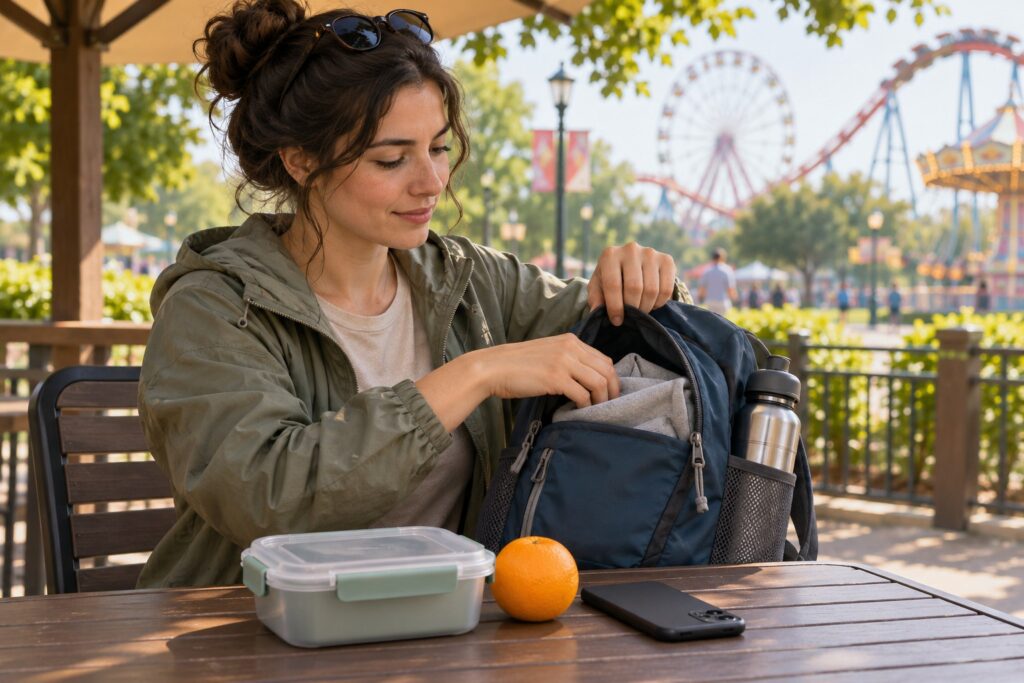
A lunch option on the other side of the park becomes less useful when your next attraction commitment is approaching and you still need to discuss ingredients. For a gluten-free park day, the meal itself and the time available to arrange it belong in the same plan.
Start with one realistic lunch option, an alternative you can actually access and a clear way to explain your requirements. Then fit those arrangements around your day rather than leaving food until the gap between rides disappears.
For accommodation meals, arrival arrangements and the wider stay, see our guide to planning gluten-free meals for an Orlando visit from Indonesia. Here, the focus is the day spent inside a theme park.
Put meals on the same map as your attractions
Identify the exact park you will enter and the areas where you expect to spend the morning and afternoon. Check candidate dining locations against that route. A restaurant elsewhere in the resort is a separate travel arrangement, even if it appears in the same dining search.
Record breakfast, lunch and the likely dinner situation. If you intend to stay into the evening, establish whether dinner will happen inside the park or after leaving. Avoid letting an uncertain departure time become an equally uncertain meal.
For each park meal, save three things: the exact venue, a candidate dish to discuss and the alternative if it does not work. Check current service hours and any reservation requirements through the operator. A dining reservation can organize your schedule; it does not establish that a particular meal meets your requirements.
Leave space before and after lunch for walking, asking questions, preparation and eating. There is no useful universal allowance for this. Choose a meal window that does not depend on every earlier activity finishing exactly as expected.
For example, in a hypothetical itinerary, a family might investigate lunch in the area they expect to reach before an afternoon show. If the morning changes, they can move lunch earlier or use their established alternative instead of crossing the park while rushing the dietary conversation.
Check the dietary-request process for your chosen operator
Use the operator’s current guidance to understand how to begin your request. Then narrow the enquiry to the location and meal you intend to use. Resort-wide information does not settle every kitchen’s ingredients, equipment or availability.
Walt Disney World
Disney lists gluten among the ingredients its table-service and quick-service restaurants will try to accommodate requests to avoid. It also explains that requests cannot be guaranteed. Share your requirements with the Cast Member assisting with your order when you arrive. Disney’s Special Dietary Requests guidance
The same guidance describes an advance-contact process for certain complex dietary needs and limits that process to Disney-owned and operated restaurants. If your circumstances fit its criteria, follow the current instructions and contact window. Do not assume that every gluten-free request requires that process or that every restaurant associated with a Disney visit uses it.
Universal Orlando
Universal’s official FAQ states that its full-service restaurants can accommodate special dietary needs and encourages guests to research menus in advance or speak with a manager or chef on-site. Treat this as the operator’s stated accommodation process, rather than confirmation of your specific order. Universal Orlando dining FAQ
For a quick-service outlet, kiosk or temporary offering, ask about that location separately. The FAQ’s full-service statement should not be extended to every food counter. At either resort, establish who can answer preparation questions before committing to an order.
Ask about one complete meal
Choose a candidate dish and work through its components: sauces, marinades, seasoning, coatings, toppings and sides. A familiar dish name is a useful starting point, but it does not identify the recipe used at that venue.
Preparation needs its own conversation. Cross-contact can introduce gluten during storage, preparation or serving, as explained in the NIDDK guide to eating with celiac disease. That is why checking ingredients alone leaves part of the decision unresolved.
Match your questions to the dish. For fried food, ask what else uses the fryer and oil. For a toasted sandwich, ask about the toaster, work surface and utensils. For a grilled dish, clarify the marinade and cooking arrangement. You do not need to ask every possible kitchen question about every meal.
A short opening could be:
I need a gluten-free meal. Could someone familiar with the kitchen check this dish, including its sauce, seasoning and sides, and explain how it would be prepared? Please tell me what cannot be confirmed.
State celiac disease or a wheat allergy only if it accurately describes your situation. Explain separate allergies, halal requirements or other restrictions explicitly. A gluten-free request does not communicate all your dietary needs.
Before paying, ask how the order will be identified and collected. If you are considering mobile ordering, establish whether that route can communicate your requirements and connect you with the necessary staff. Do not assume that selecting a menu option replaces the conversation you need.
Make carried food a usable backup
Decide what meal gap your backup needs to cover before choosing what to pack. A small snack may help during a delay, while a missed lunch calls for a more substantial arrangement. Choose food you have assessed against your requirements and can eat under the conditions available.
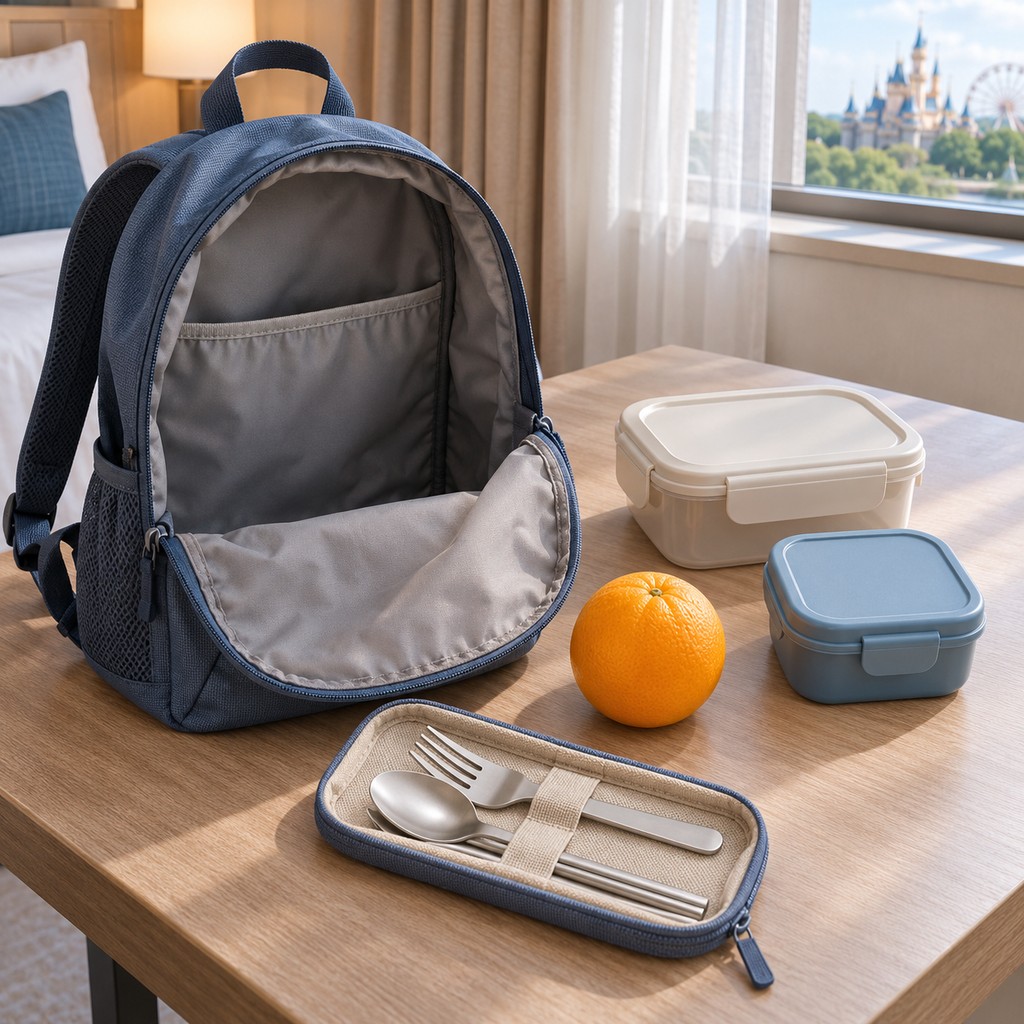
Food-entry rules differ between operators. Universal currently lists food for special dietary needs among acceptable outside items and states that food cannot require heating or refrigeration. Check its complete outside-food and container policy for your intended food and bag.
Disney’s published guidance says its staff cannot store, prepare, cook or reheat food brought by guests. Check the current Disney property rules alongside its dietary guidance before deciding what to carry. Confirm container, bag and cooling restrictions rather than assuming a setup permitted elsewhere will be accepted.
Follow the food’s storage instructions. Permission to bring an item through the entrance does not establish that it can remain in your bag all day. If the food depends on facilities or cooling arrangements you cannot confirm, choose another backup.
Keep packaging available when it contains information needed for your decision. Pack any permitted utensils you need, and keep your own portion distinguishable from companions’ shared snacks. Food left at the hotel is an alternative only if returning there is realistic within your admission and transport arrangements.
Agree on when to change the plan
Tell companions before entering the park that lunch may involve a conversation and a different collection process. Agree on a meal window and who will keep track of the next attraction commitment. This reduces the pressure to accept an unresolved answer simply because everyone is ready to move on.
Choose a practical decision point for using your alternative. That could be when staff cannot clarify an important ingredient, the proposed preparation cannot meet your requirements or the meal cannot be arranged within the time you have available.
If answers conflict, ask whether someone responsible for the kitchen can clarify the actual order. Keep the uncertainty specific: an unanswered marinade question remains unanswered even if another component has been checked. You can move to your alternative without trying to settle the suitability of the entire restaurant.
Revisit changes to the order before accepting them. A replacement side or sauce can alter what you previously discussed. At collection, confirm that the meal is the order prepared for your request rather than relying on its appearance.
A workable park day leaves room for enjoyment because the fallback is already usable. You know where you intend to eat, what still needs asking and what you will do if the first arrangement falls through. The aim is to make the next decision manageable, even when the itinerary changes.