
A promising airport restaurant is useful only if you can reach it, order a suitable meal and return to your gate in time. A listing elsewhere in the airport may offer little help when your connection keeps you in a different terminal or you arrive after its kitchen closes.
Planning gluten-free meals during an airport layover starts with access and timing, then moves to ingredients and preparation. Choose a candidate you can realistically use, and establish what you will eat if that arrangement falls through.
For the wider journey, our guide to planning gluten-free travel from Indonesia connects transport meals, destination arrangements and backup options. Here, the focus is the meal gap between flights.
Start with the part of the airport you can access
Write down your expected arrival terminal, departure terminal and any transfer steps supplied by your airline or airport. Check whether a candidate food outlet is in the public area before security or the restricted departure area after it. An airport-wide search result does not establish that the outlet is accessible on your connection.
Use the airport’s official map and transfer guidance alongside its dining directory. Look for the exact branch and location, rather than relying on a restaurant brand’s presence somewhere at the airport. If you would need to leave the transit area, establish the entry requirements and return process before considering that option.
For example, Changi Airport’s dining directory distinguishes outlets by terminal and public or transit location. That helps identify candidates for further checking; it does not establish that a listed meal meets your dietary requirements.
For a journey starting in Indonesia, assess each connection separately. Research for one transit airport cannot resolve access, food availability or procedures at another. Save the relevant map and outlet details so that your plan does not depend entirely on finding information after landing.
Work backwards from when you need to be at the gate
Use the boarding and gate instructions for your actual flight as the endpoint. Then account for transfers, any required checks, walking, ordering, preparation and eating. The scheduled time between flights is not all available for a meal.
Avoid a universal rule such as assuming that every two-hour connection allows a restaurant stop. The practical question is whether this particular stop fits after the necessary connection tasks, with room for uncertainty.
| Connection situation | Meal approach to consider | What needs confirming |
|---|---|---|
| Little usable time after transfer tasks | Food already carried and permitted on the route | Accessible storage and somewhere practical to eat |
| Time for a stop near the departure gate | One nearby outlet, with a backup | Current kitchen hours, ingredients and preparation |
| Longer wait in an accessible terminal | A checked meal option followed by time near the gate | Transfer route, service time and any access restrictions |
| Overnight or disrupted connection | Carried food plus any confirmed operating outlet | Which outlets are actually serving when you arrive |
Set a personal decision point: if you have not established a workable meal by the time you need to move toward your gate, use the alternative. This is a planning choice based on your itinerary, rather than an airport-wide timing standard.
Check one candidate meal, including its preparation
Contact the exact outlet where possible and ask about a specific dish. Include sauces, marinades, seasoning, coatings and toppings. A dish described as rice, vegetables or grilled meat still needs its actual ingredients clarified.
Preparation matters alongside ingredients. The NIDDK guide to eating with celiac disease explains that cross-contact can introduce gluten during storage, preparation or serving. A menu description alone therefore leaves part of the decision unanswered.
Ask questions that follow the proposed meal:
- For fried food, what else uses the fryer and oil?
- For a toasted item, which toaster, preparation surface and utensils would be used?
- For a cooked dish, can staff identify the sauce or marinade and explain the cooking arrangement?
- For a displayed meal, how would your portion be handled and served?
A short request could be: “I need a gluten-free meal. Could someone familiar with the kitchen check this dish’s ingredients, including its sauce and seasoning, and explain the preparation equipment and utensils? Please tell me what cannot be confirmed.”
Mention celiac disease or a wheat allergy only if it accurately describes your situation. Communicate separate allergies, halal requirements or other restrictions explicitly rather than assuming a gluten-free request covers them.
Keep replies specific. “We can leave off the sauce” answers that proposed change; it does not establish what is in the marinade or how the food is cooked. If an important answer remains unavailable, retain that uncertainty and consider your alternative.
Make the backup usable without airport facilities
Choose enough food to cover the meal gap you are planning for, rather than treating one small snack as a complete contingency. Prefer options you have assessed against your requirements and can eat under the conditions available, without depending on a microwave, refrigerator or restaurant utensils.
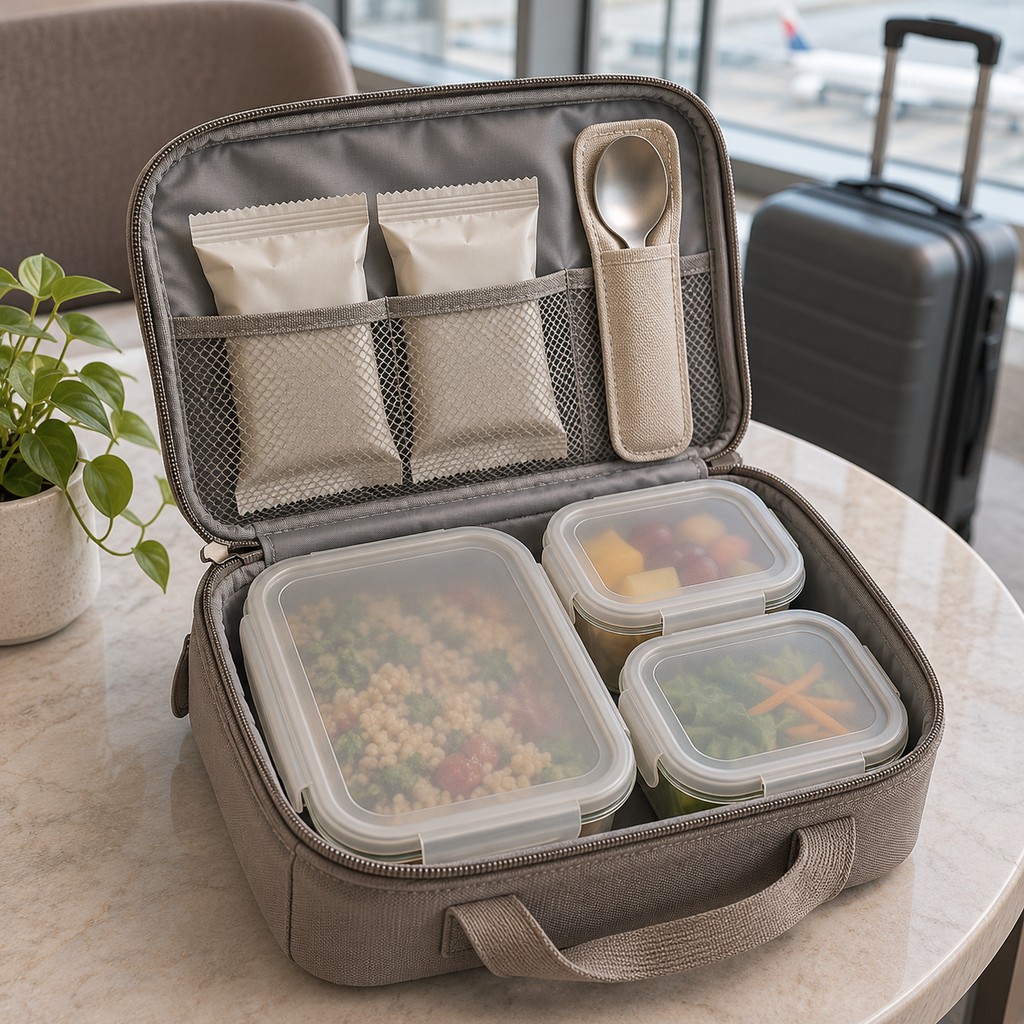
Keep the current packaging available when you need its ingredient or storage information. Pack food where you can reach it during the connection, with any permitted utensils it requires. Follow its storage instructions; a gluten-free claim does not answer ordinary food-storage questions.
Before departure, check the relevant security authority, airline and customs or biosecurity guidance for the actual food, containers and cooling equipment you intend to carry. Establish what applies at transit and arrival as well as at your first airport. This article does not confirm permission for any particular item or route.
Think about the whole journey when allocating supplies. If your backup is also meant to cover an unavailable onboard meal, decide how much remains for the layover. A hypothetical traveller who eats all their carried food on the first flight has lost the alternative they intended to use during the connection.
Reassess once you land
Confirm your onward gate and connection tasks before heading toward food. If the terminal, route or available time has changed, update the meal plan around the new circumstances.
At the outlet, confirm the dish and preparation arrangement with the staff handling your order. An earlier message is useful context, but it does not establish that ingredients, staffing or availability remain unchanged. Ask again about a substitution that changes a component you previously discussed.
For packaged food, read the package actually offered. Do not substitute an unfamiliar product solely because its branding resembles something you buy at home. If you cannot understand information needed for your decision, seek clarification or use a product you can assess.
During a delay, ask which outlets in your accessible area are still serving food and whether their kitchens have separate closing times. A general statement that dining is available does not identify a usable gluten-free meal.
You might find a suitable meal, choose your carried food or combine a checked purchase with part of your backup. The useful outcome is an arrangement that fits your dietary requirements and leaves enough time to reach the gate without rushing the conversation that informs your choice.